
Manufacturing plants that produce packaging components, insulation boards, and protective inserts generate trim scrap throughout daily operations. Extrusion, cutting, and molding processes produce off-cuts of expanded plastics such as EPS, EPE, and EPP. These materials perform well in finished products, yet their structure creates complications once they enter waste streams.
Expanded foam contains large volumes of trapped air. EPS, for example, consists of roughly 95-98 percent air. The structure gives foam its cushioning behavior while creating storage and transport challenges.
Facilities typically encounter three operational issues:
- Scrap containers fill quickly despite low material weight
- Loose trim spreads across storage areas
- Transport loads carry mostly air rather than polymer
Waste systems designed for rigid plastics rarely address these conditions effectively. Expanded foam requires a different handling strategy.
Why Traditional Foam Waste Handling Breaks Down
Density Drives Transport Cost
Freight economics depend on payload density. Containers reach capacity based on available space, not weight. Loose foam scrap fills containers rapidly while delivering minimal polymer mass.
The result is a transport imbalance: shipping operations move large volumes of material with limited weight.
Scrap Storage Inside Plants
Foam trim also disrupts plant organization. Off-cuts accumulate near cutting stations and converting equipment. Operators often collect scrap manually several times during a shift. This repeated activity increases labor requirements without improving production output.
Mechanical Compression Limitations
Some plants attempt to control scrap volume using a foam compactor. Mechanical compression reduces bulk temporarily. Air pockets often expand again once compression pressure releases. Baled foam also requires metal wire bands to hold the bales together and still occupies significant shipping space.
These limitations encourage facilities to evaluate densification methods that permanently alter foam density.
Operational Indicators That Densification Is Required
Manufacturing plants often recognize foam-handling limits through daily operating patterns.
Common indicators include:
- Frequent dumpster turnover during production shifts
- Trim accumulation near extrusion or converting equipment
- Shipping containers reaching volume capacity before weight limits
- Recycling partners requesting denser material formats
When these patterns occur regularly, the underlying issue typically relates to foam density rather than scrap volume.
Engineering Principle of Foam Densification
Removing Air From Expanded Plastics
Full-melt densification targets the physical structure of foam. Controlled heating collapses the cellular matrix and releases trapped air. The polymer softens and transitions from expanded foam into molten plastic.
Once the air leaves the material, the polymer occupies far less volume.
Why Melt Processing Produces Stable Density
Mechanical compression relies on external pressure. Melt densification changes the internal structure of the material itself. After cooling, the polymer retains a stable dense form without re-expansion.
This stability allows reliable handling, stacking, and transport.
Step-by-Step Workflow of Full-Melt Foam Densification
Full-melt densification converts loose foam trim into dense recyclable bricks through a controlled processing sequence.
Stage 1 – Size Reduction
Trim scrap enters a hopper equipped with a shredder that breaks larger pieces into smaller fragments. Uniform feedstock ensures stable flow through the system. Industrial facilities often use a heavy-duty industrial shredder designed to process resilient materials such as EPE and EPP.
Consistent particle size prevents bridging inside the densification chamber.
Stage 2 – Controlled Material Feeding
Shredded foam moves into the heating chamber through an auger compactor. The auger maintains steady feed pressure and regulates material throughput. Controlled feeding ensures uniform heating and stable densification performance.
Stage 3 – Thermal Air Release
Heat collapses the foam’s cellular structure. Gas trapped inside the cells escapes while the polymer softens and becomes molten plastic.
This stage removes the internal air responsible for most of the foam’s original volume.
Stage 4 – Formation of Dense Bricks
Molten plastic exits the machine through a die and then flows into a brick mold where it forms dense rectangular block. The bricks cool quickly and maintain stable density during storage and transport.
Why Recyclers Prefer Dense Foam Material
Recycling processors require feedstock that moves easily through grinding and pelletizing systems. Loose foam scrap rarely satisfies this requirement.
Dense bricks offer several advantages.
Recycling advantages include:
- Higher polymer mass per shipment
- Stable stacking during storage
- Consistent grinding feedstock
- Efficient pellet production
Many recycling facilities actively purchase densified EPS foam because it improves transport efficiency and simplifies downstream processing.
Operational Benefits for Manufacturing Plants
Foam densification improves waste handling across several operational areas.
| Operational Factor | Impact |
| Volume reduction | Large decrease in scrap storage footprint |
| Transport efficiency | Higher material payload per container |
| Workplace organization | Less loose foam around production equipment |
| Labor efficiency | Reduced manual scrap collection |
| Recycling revenue | Marketable densified EPS foam |
These improvements convert foam waste from a logistical problem into a manageable material stream.
Example of Integrated Foam Densification Systems
How the AD Series Processes Foam Scrap
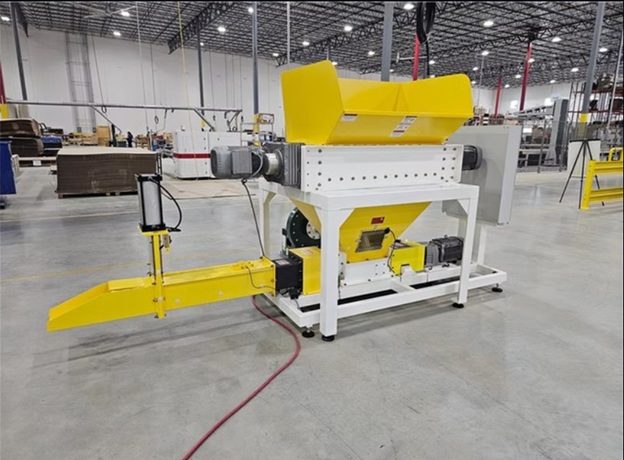
Manufacturers increasingly install integrated densification equipment that combines shredding, feeding, and thermal processing into a single workflow. One example appears in JTW International’s AD Series Foam Scrap Densifiers, designed for EPS, EPE, and EPP scrap processing inside plastics manufacturing plants.
The system architecture integrates several processing components:
- hopper-fed shredder for trim size reduction
- feed mechanism driven by an auger compactor
- heated chamber that collapses foam structure
- die system that forms dense, recyclable bricks
Many facilities replace traditional scrap methods or a standard foam compactor with full-melt densification systems. Installation typically requires a single three-phase power connection and minimal floor space. PLC-based controls simplify operation and allow plant operators to manage the system easily.
Manufacturers frequently install densifiers near extrusion or converting lines so scrap moves directly from production equipment into the recycling process.
See a detailed technical overview here: AD Series Foam Scrap Densifier System.
Integration Factors Manufacturers Evaluate
Manufacturers often review several operational variables before installing densification equipment.
Key evaluation factors include:
- Scrap generation rate from extrusion lines
- Material mix such as EPS, EPE, or EPP
- Available floor space for processing equipment
- Recycling partnerships that purchase dense material
Facilities that evaluate these factors carefully often integrate densification systems more effectively.
Foam Scrap Processing in Modern Manufacturing
Manufacturers increasingly treat scrap materials as recoverable resources rather than disposal waste. Recycling markets continue to demand dense polymer feedstock suitable for pellet production.
Densification equipment allows plants to process scrap directly at the source. Integrated systems maintain continuous scrap handling while improving plant organization. Facilities prepare dense recyclable material for transport without interrupting production.
This approach reflects a broader shift within plastics manufacturing toward material recovery and resource efficiency.
Key Takeaways for Manufacturing Operations
Several practical insights emerge from foam recycling practices.
- Foam waste logistics problems originate from low density
- Mechanical compression rarely resolves transport inefficiency
- Thermal densification removes internal air permanently
- Integrated systems maintain continuous scrap processing
- Dense bricks convert waste into recyclable raw material
Facilities that adopt densification technology gain better control over both waste management and recycling value.
Conclusion
EPS, EPE, and EPP scrap create a unique waste-handling challenge in manufacturing environments. Expanded structures contain large volumes of air, which leads to inefficient storage and transport conditions. Traditional waste systems rarely address these issues effectively.
Full-melt densification changes the structure of foam scrap. Heating collapses the cellular matrix and removes trapped gases, converting bulky trim into dense recyclable plastic.
Modern manufacturing plants increasingly deploy systems that combine shredding, controlled feeding, and thermal densification. Equipment built around an industrial shredder machine and densification technology enables facilities to transform foam waste into recyclable material that moves efficiently through the recycling supply chain.