
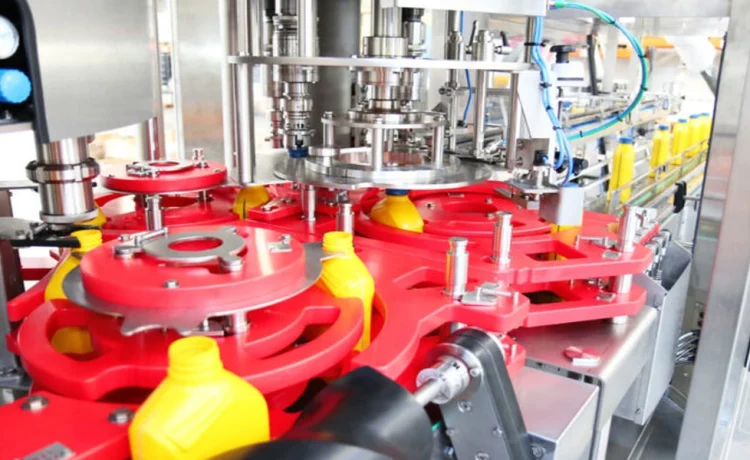
A jerrycan filling machine is the piece of equipment that turns jerrycan packaging from a labour-intensive manual operation into a fast, accurate, and repeatable production process. The jerrycan format – typically between 5 and 25 litres, with a robust handle, sealed closure, and stackable design – is one of the most widely used bulk liquid containers across industrial chemicals, automotive fluids, agricultural products, lubricants, and food-grade liquids. Getting the filling process right for this container format means matching the machine’s filling principle to the product’s characteristics and the production line’s throughput requirements.
Why the Jerrycan Format Creates Specific Filling Challenges
The jerrycan’s narrow neck opening, which makes it robust and easy to seal, creates a filling challenge that wider-mouth containers do not present in the same way. High-speed filling through a relatively small aperture requires careful nozzle design to deliver product at the target flow rate without creating turbulence, foaming, or splash that contaminates the container exterior.
The range of products filled into jerrycans also spans a wide viscosity spectrum. Thin chemical solvents, agricultural herbicides, automotive brake fluid, and edible cooking oils are all filled into jerrycans, but their flow characteristics are very different. A filling machine optimised for thin, free-flowing liquids will not perform correctly with a thicker lubricant or a viscous food product. The filling principle must match the product.
Container size variation within the jerrycan format adds a further consideration. A production line that fills 5-litre, 10-litre, and 20-litre jerrycans needs a machine that can accommodate these different volumes with rapid changeover rather than extended downtime between runs.
Filling Principles Used in Jerrycan Filling Machines
Jerrycan filling machines use several filling principles, each suited to different product types and accuracy requirements.
Piston filling uses a precision piston-and-cylinder mechanism that draws a measured volume of product from the supply and expels it through the fill nozzle into the container. Each fill cycle delivers the same volume regardless of minor variations in product supply pressure. Piston filling handles a wide viscosity range well, making it a versatile choice for production lines that fill multiple product types.
Gravimetric or weight-based filling positions the jerrycan on a load cell platform and fills until the target weight is reached, at which point the fill valve closes automatically. This method compensates for product density variation between batches – relevant for products whose concentration or temperature affects density – and is the most accurate approach for high-value products where overfill represents significant financial loss.
Flow meter filling measures the volume of product flowing through the system using an inline flow meter and cuts off the fill when the target volume is reached. This is fast and well-suited to consistent-density thin liquids such as water-based chemicals and light oils.
Bottom-up or submerged filling inserts the fill nozzle into the jerrycan opening and fills from the bottom upward, with the nozzle withdrawing as the liquid level rises. This approach minimises foaming in aerated products and reduces vapour generation in volatile liquids, making it the preferred method for solvents and other volatile chemical products.
Speed and Precision Working Together
The two headline performance requirements for a jerrycan filling machine, speed and precision, are sometimes treated as being in tension, but well-engineered filling equipment demonstrates that they are not.
Speed is achieved through higher flow rates at the fill nozzle, parallel filling of multiple containers simultaneously on multi-head machines, and fast-acting fill valves that cut off cleanly without drip. Precision is achieved through the filling principle and its measurement accuracy, the response speed of the cut-off mechanism, and the consistency of the product supply pressure.
The practical throughput of automatic jerrycan filling machines in Singapore production operations typically ranges from 10 to 30 units per minute for single-head machines, depending on container volume and product type. Multi-head configurations filling two or four containers simultaneously multiply this base throughput proportionally.
As Singapore’s Economic Development Board has noted in its guidance on manufacturing productivity investment, “Filling line automation that combines speed with accuracy delivers returns not only through throughput increase but through the elimination of product give-away from overfilling and rework from underfilling.” Both losses are measurable and significant at production scale.
Safety Requirements for Hazardous Products
Many products filled into jerrycans in Singapore’s industrial and chemical manufacturing sector are flammable, corrosive, or otherwise hazardous. Jerrycan filling machines for hazardous products must be designed and certified for these applications.
Key safety requirements include explosion-proof electrical components for flammable liquid filling, earthing and bonding connections between the machine, the product supply system, and the container to prevent static charge build-up during filling, and materials compatibility throughout the product pathway for corrosive chemicals. Singapore’s Workplace Safety and Health Act and Fire Safety Act impose obligations on operators of equipment used with flammable and hazardous materials, and the filling machine specification must meet these requirements from the outset.
Line Integration and Automation
Automatic jerrycan filling machines in production operations are most effective when integrated into a complete filling line rather than operated as standalone stations with manual container handling before and after filling. A complete integrated line includes empty container infeed and conveying, the filling station, automatic capping, inline check weighing to verify each filled container, labelling, and palletising for despatch.
This integration eliminates the inter-station handling that fragments efficiency in partially automated operations and ensures that every container that leaves the line is correctly filled, capped, and labelled. For Singapore manufacturers operating in a tight labour market where production headcount is a significant cost, line integration reduces the manual labour requirement while improving output consistency and traceability.
Selecting the Right Machine
The right jerrycan filling machine for a Singapore production operation depends on a clear specification of product type and viscosity, required fill accuracy, container size range, target throughput, safety classification of the product, and downstream line integration requirements. A specialist supplier with application experience across different jerrycan filling configurations provides the most reliable guidance through this selection, and local service capability after installation ensures the machine performs reliably for the long term.